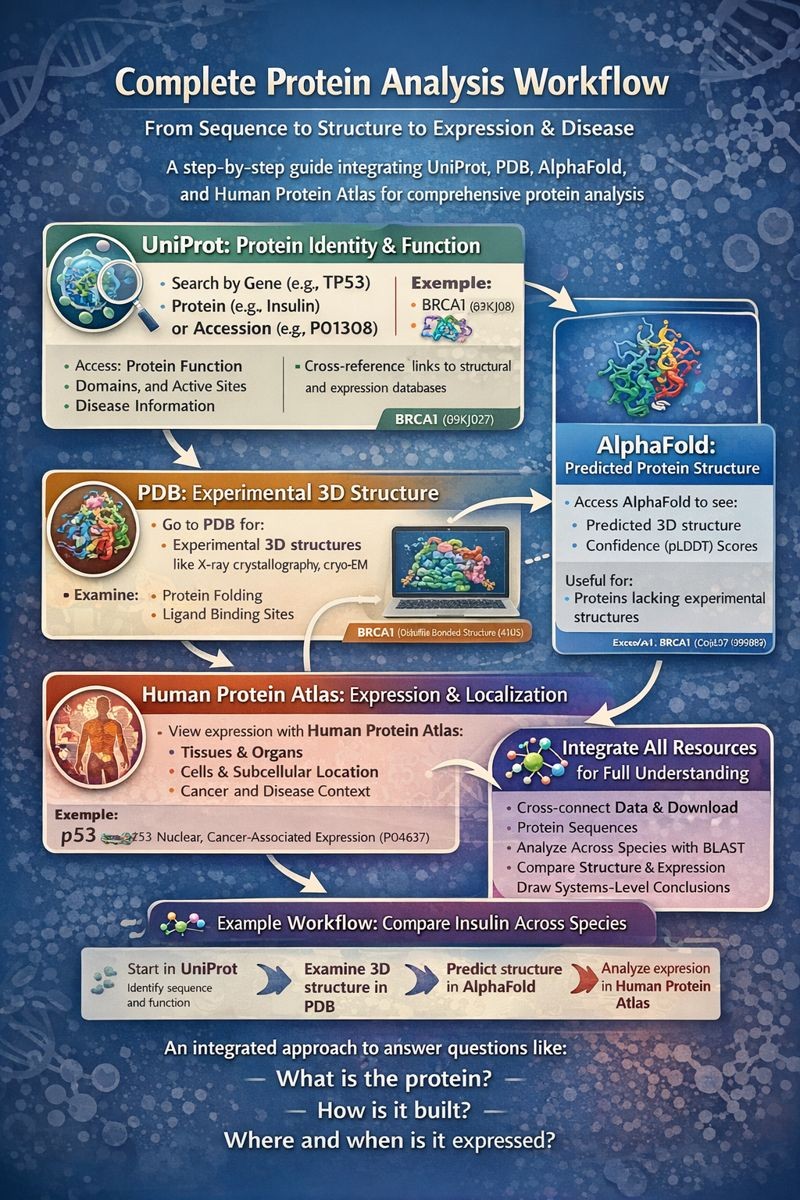
Proteomics in Action: Case Studies and Integrated Database Use
Proteomics becomes meaningful to when abstract concepts—such as protein expression, structure, and interactions—are linked to real diseases and real drugs. The following case studies demonstrate how proteomic data flows through UniProt → PDB → AlphaFold → Human Protein Atlas to support drug discovery and clinical decision-making. Let us look at some of the examples to see how proteomics is used in disease management and their treatment.
(I) CASE STUDY 1: HER2 in Breast Cancer
Biological Background
HER2 (Human Epidermal Growth Factor Receptor 2) is a
membrane receptor tyrosine kinase.
Overexpression of HER2 leads to uncontrolled cell
division and is associated with
aggressive breast cancer.
1. UniProt: Protein Identity and Function
- UniProt entry: ERBB2 (HER2)
-
What students learn:
- Protein function: receptor tyrosine kinase
- Role in cell growth signaling
This will help you to understand why HER2 is a cancer drug target?
2. PDB: Experimental Protein Structure
PDB
structures show:
- The extracellular domain of HER2
- The kinase domain bound to inhibitors
Trastuzumab (Herceptin) binds to the extracellular domain of HER2, blocking receptor activation. You can understand how drug binding relates to protein structure.
3. AlphaFold: Full-Length Structure Prediction
AlphaFold provides:
- A predicted structure of full-length HER2
- Structural regions missing from PDB entries
You will be able to infer how AlphaFold complements experimental data when full structures are unavailable.
4. Human Protein Atlas (HPA): Expression Evidence
HPA shows:
- High HER2 expression in certain breast tumors
- Variable expression across normal tissues
This will helps us to connect protein overexpression with disease diagnosis and prognosis.
So proteomics explains why HER2 is a drug target, how drugs bind, and where the protein is overexpressed in cancer.
(II) CASE STUDY 2: BCR–ABL in Chronic Myeloid Leukemia (CML)
Biological Background
BCR–ABL is a fusion protein created by a chromosomal translocation. It has constitutive kinase activity, driving leukemia.
1.UniProt
Describes:
- Fusion protein function
- Oncogenic kinase activity
2. PDB
Shows: Imatinib fits precisely into the ATP-binding pocket of ABL kinase.
- ABL kinase domain bound to Imatinib (Gleevec)
3. AlphaFold used to:
- Predict structures of mutant forms of BCR–ABL
- Study drug resistance mutations
4. Human Protein Atlas: confirms:
- Expression in hematopoietic cellsL
- Absence in most normal tissuess
So proteomics enables targeted cancer therapy, one of the greatest successes of modern medicine.
III) CASE STUDY 3: p53 – Tumor Suppressor Protein
Biological Background
p53 is a transcription factor known as the “guardian of the genome.” Mutations in p53 occur in over 50% of cancers.
1. UniProt shows:
- DNA-binding function
- List of cancer-associated mutations
- Isoforms produced by alternative splicing
2. PDB : structures show:
- DNA-binding domain
- How mutations destabilize structure
3. AlphaFold predicts:
- Full-length p53 structure
- Disordered regions involved in regulation
4. Human Protein Atlas (HPA) shows:
- Nuclear localization
- Strong association with cancer prognosis
So structural changes in proteins can explain loss of tumor suppressor function.
(IV) CASE STUDY 4: PSA (Prostate-Specific Antigen) – Cancer Biomarker
Biological Background
1. UniProt provides:
- Enzymatic activity
- Secretion signal peptide
2. PDB / AlphaFold show:
- Active site architecture
- Protease mechanisme
3. Human Protein Atlas
Confirms:
- High expression in prostate tissue
- Presence in blood (ideal for screening)
Clinical Insight: PSA screening can detect cancer early, however, false negatives and positives exist.
Drawing upon major resources like UniProt, the PDB, AlphaFold, and the Human Protein Atlas, proteomics enables a comprehensive, systems-level view of disease biology. This integrated approach is supported by key public repositories for proteome data, including the Human Protein Atlas (HPA), UniProt and its detailed UniProt Knowledgebase.