Proteomics & Metabolomics: Assessment Question Bank

Biotechnology4you.com Proteomics & Metabolomics: Assessment Question Bank

Proteomics & Metabolomics: Assessment Question Bank

This question bank covers key concepts in Proteomics and Metabolomics. Designed for undergraduate-level students.

Part A: Short Answer Questions (4 marks each) [H]
1. Describe one key advantage and one key limitation of using Nuclear Magnetic Resonance (NMR) spectroscopy in metabolomic studies.
Advantage:
  • Highly quantitative and reproducible
  • Minimal sample preparation
  • Non-destructive and provides direct structural information
Limitation:
  • Lower sensitivity compared to mass spectrometry (MS), limiting detection of low-abundance metabolites
2. What is the primary functional difference between a biomarker and a protein signature in cancer diagnostics?
A biomarker is a single molecule (such as one protein) whose level indicates a disease state. A protein signature is a defined set of multiple proteins whose combined expression pattern provides a more specific and reliable diagnostic or prognostic indicator than any single biomarker alone.
3. Briefly explain the concept of pharmacometabolomics. What is its primary goal in personalized medicine?
Pharmacometabolomics is a sub-field that uses metabolomic profiling to predict an individual’s metabolic response to a drug. Its primary goal is to guide personalized drug selection and dosing to maximize therapeutic efficacy while minimizing adverse effects.
Part B: Multiple Choice Questions (1 mark each)

(Select the single best answer)

Biochemistry Fundamentals
1. Which of the following is a reversible post-translational modification that acts as a primary molecular switch in cell signaling?
  • a) Glycosylation
  • b) Ubiquitination
  • c) Phosphorylation
  • d) Proteolytic Cleavage
2. The covalent attachment of a carbohydrate chain to an asparagine residue is an example of:
  • a) N-linked Glycosylation
  • b) O-linked Glycosylation
  • c) Phosphorylation
  • d) SUMOylation
4. A major challenge in using single protein biomarkers (e.g., PSA) for early cancer detection is:
  • a) They are too expensive to measure.
  • b) They can only be found in tissue biopsies.
  • c) They often have high rates of false-negative or false-positive results.
  • d) They are not secreted into body fluids.
Metabolomics Concepts & Techniques
7. The complete set of small-molecule metabolites within a biological system at a given time is called the:
  • a) Genome
  • b) Proteome
  • c) Transcriptome
  • d) Metabolome
8. Compared to Mass Spectrometry (MS), a key advantage of Nuclear Magnetic Resonance (NMR) in metabolomics is:
  • a) Much higher sensitivity for low-abundance metabolites.
  • b) Minimal sample preparation and high quantitative reproducibility.
  • c) Ability to detect thousands more metabolites per run.
  • d) Lower cost of instrumentation.
9. In a typical LC-MS metabolomics workflow, the Liquid Chromatography (LC) step is used primarily to:
  • a) Ionize the metabolite molecules.
  • b) Separate metabolites based on chemical properties before MS analysis.
  • c) Detect the mass-to-charge ratio of metabolites.
  • d) Quantify the absolute concentration of each metabolite.
10. Which field applies metabolomic profiling to understand how an individual's metabolism influences their response to a drug?
  • a) Pharmacogenomics
  • b) Pharmacometabolomics
  • c) Toxicogenomics
  • d) Nutrigenomics
Integration and Applications
11. In the systems biology "omics" pipeline, metabolomics is said to answer the question:
  • a) "What could happen?"
  • b) "What is being executed?"
  • c) "What is actually happening?"
  • d) "What is inherited?"
12. The "Warburg Effect," often studied in cancer metabolomics, refers to:
  • a) Increased oxidative phosphorylation.
  • b) Preferential use of glycolysis for energy, even in oxygen-rich conditions.
  • c) Overactivation of the ubiquitin-proteasome system.
  • d) Global hypomethylation of DNA.
13. A researcher wants to study how a high-fat diet changes real-time metabolic output in liver tissue. The most direct 'omics' approach would be:
  • a) Genotyping the mice for lipid metabolism genes.
  • b) Performing RNA-seq on liver extracts.
  • c) Conducting NMR or MS on liver tissue metabolites.
  • d) Profiling liver membrane proteins.
Questions onTechnique Comparison
14. Which combination of techniques would provide the MOST comprehensive metabolomic profile of a blood serum sample?
  • a) ELISA and Western Blot
  • b) LC-MS and ¹H-NMR
  • c) PCR and Microarray
  • d) SDS-PAGE and Chromatography
15. 15. For identifying and quantifying a known, low-abundance phosphorylation site on a signaling protein in a tumor sample, the best approach is:
  • a) Genome sequencing.
  • b) Liquid chromatography with tandem mass spectrometry (LC-MS/MS).
  • c) ¹H-NMR spectroscopy.
  • d) Bulk metabolomic profiling.

Case-Based Questions (16–20)

Scenario:
A 55-year-old patient is being monitored for potential recurrence of colorectal cancer (CRC). Current imaging is inconclusive. A research team analyzes his annual blood plasma samples (from pre-diagnosis to now) using a multi-omics approach.
16. To search for new protein indicators of early CRC recurrence, the team should perform:
  • a) Genomic sequencing of his tumor.
  • b) Quantitative proteomic profiling of his plasma.
  • c) NMR-based metabolomics on his urine.
  • d) Transcriptomics on white blood cells.
17. The proteomic analysis reveals a set of 5 proteins that are elevated. This is best described as a:
  • a) Genetic mutation panel.
  • b) Metabolic pathway.
  • c) Protein signature.
  • d) Glycan array.
18. Concurrently, the team uses MS to find elevated levels of succinate, fumarate, and specific amino acids in his current plasma. This analysis is an example of:
  • a) Proteomics
  • b) Metabolomics
  • c) Genomics
  • d) Transcriptomics
19. The finding of elevated mitochondrial TCA cycle intermediates (succinate/fumarate) in plasma likely indicates:
  • a) Normal liver function.
  • b) Altered mitochondrial metabolism in possible tumor cells.
  • c) Successful response to chemotherapy.
  • d) A high-carbohydrate diet.
20. Integrating the proteomic signature with the metabolomic data provides a major advantage because it:
  • a) Reduces the cost of the tests.
  • b) Offers a more comprehensive, functional picture of the potential disease state.
  • c) Eliminates the need for imaging.
  • d) Guarantees a definitive diagnosis.

Part C: True or False (1 mark each)

[E] Answer True or False for the following statements.

21. True / False: Ubiquitination always marks a protein for destruction by the proteasome.
22. True / False: Mass Spectrometry (MS) has higher sensitivity than NMR for detecting low-concentration metabolites.
23. True / False: A "false negative" in biomarker testing means the test incorrectly detected a disease that is not present.
24. True / False: Metabolomics can be used to monitor a patient's response to a drug treatment over time.
25. True / False: In metabolomics, GC-MS is best suited for analyzing large, non-volatile proteins.
26. True / False: The National Cancer Institute's "Early Detection Research Network (EDRN)" focuses solely on genomic biomarkers.
27. True / False: Single-cell proteomics aims to analyze the average protein expression from millions of cells simultaneously.

Part C: Answer Key

21. False – Ubiquitination can also have non-degradative signaling roles.
22. True
23. False – This describes a false positive; a false negative fails to detect a present disease.
24. True
25. False – GC-MS is suited for small/volatile molecules, not proteins.
26. False – EDRN includes proteomic and metabolomic biomarkers as well.
27. False – Single-cell proteomics analyzes protein expression from individual cells.

Part D: Fill in the Blanks (1 mark each)

[E] Fill in the appropriate term in each blank.

31. The enzyme that adds a phosphate group to a protein is called a .
32. In metabolomics, combines separation of molecules in a liquid phase with detection based on mass-to-charge ratio.
33. The metabolic phenomenon where cancer cells rely heavily on glycolysis is called the Effect.
34. The protein is a classic, though imperfect, biomarker used in the monitoring of ovarian cancer.

Part D: Answer Key

31. Kinase
32. LC-MS (Liquid Chromatography–Mass Spectrometry)
33. Warburg
34. CA-125

Part E: Critical Thinking & Case Studies (5 marks each)

[H] Answer the following case studies with appropriate justification.

Case Study 1: The Ailing Athlete
A champion marathon runner presents with sudden, severe fatigue and muscle pain. Initial blood tests show no common infection. The medical team suspects a rare mitochondrial myopathy (a disorder of muscle cell energy production).
36A. Which ‘omics’ approach—proteomics or metabolomics—would provide the most direct and rapid functional insight into the suspected energy metabolism problem?
36B. If you chose metabolomics, would you recommend NMR or MS as the primary initial technique? Give one reason.
Answer:

A) Metabolomics would provide the most direct functional insight because it directly measures the small-molecule substrates and products of energy metabolism (e.g., TCA cycle intermediates, lactate, ATP/ADP ratios), offering an immediate snapshot of mitochondrial dysfunction.

B) Both NMR or MS are acceptable with justification:
  • NMR: Suitable for rapid, quantitative, and reproducible detection of major energy-related metabolites such as lactate, creatine, and amino acids in serum or urine.
  • MS: Preferred when maximum sensitivity is required to detect low-abundance intermediates or to perform broad metabolite profiling from muscle biopsy samples.
Case Study 2: Drug Development Dilemma
A new drug, “CureX,” shows excellent tumor shrinkage in 60% of melanoma patients but causes severe liver toxicity in 20%, halting its development.
37A. Propose how a proteomic strategy could explain variable patient response.
37B. Propose how a metabolomic strategy could predict or explain liver toxicity.
Answer:

A) Proteomic Strategy: Perform comparative proteomic or phosphoproteomic analysis on pre-treatment tumor biopsies from responders and non-responders. This could identify differential signaling pathways, drug targets, or resistance mechanisms associated with response.

B) Metabolomic Strategy: Analyze pre-dose and early-treatment plasma samples using MS or NMR to identify metabolic signatures (e.g., bile acids, lipid species, oxidative stress markers) that predict susceptibility to liver toxicity before clinical symptoms appear.
Case Study 3: Agricultural Improvement
A plant biologist aims to develop a drought-resistant wheat strain. Two genetically similar strains (A and B) are tested, but Strain B wilts much slower under water stress.
38. Describe a metabolomic experimental design that could explain the physiological difference.
Answer:
Grow both strains under controlled and drought-stress conditions. Collect leaf tissue at multiple time points and extract metabolites. Analyze samples using GC-MS and/or LC-MS to profile primary metabolites (sugars, amino acids) and secondary metabolites (antioxidants, stress hormones). Comparative analysis would identify metabolites such as proline, sugars, or antioxidants that accumulate preferentially in the drought-tolerant Strain B.
General Critical Thinking
39. A colleague argues that genomics alone is sufficient. Provide a two-sentence rebuttal.
Answer:
While genomics identifies underlying genetic variations, proteomics and metabolomics reveal the functional consequences and real-time physiological state of a biological system. Many diseases involve pathway dysregulation without direct genetic mutation, which can only be captured by studying proteins and metabolites.

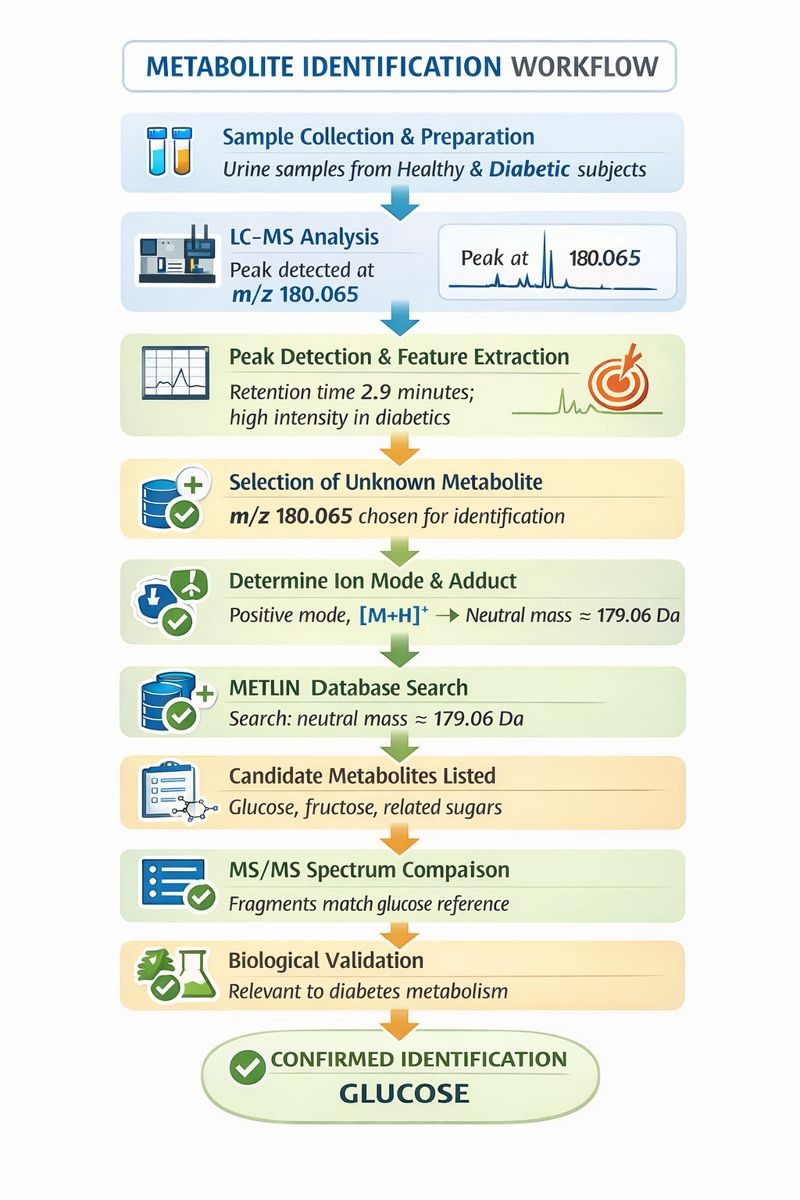
Flow Chart: METLIN Database–Based Metabolite Identification

Sample Collection & Preparation

Urine samples from healthy and diabetic subjects

LC–MS Analysis

Peak detected at m/z 180.065

Peak Detection & Feature Extraction

Retention time: 2.9 minutes; high intensity in diabetics

Selection of Unknown Metabolite

m/z 180.065 chosen for identification

Determine Ion Mode & Adduct

Positive mode, [M+H]+

METLIN Database Search

Search neutral mass ~179.06 Da

Candidate Metabolites Listed

Glucose, fructose, related sugars

MS/MS Spectrum Comparison

Fragment ions match glucose reference spectrum

Biological Validation

Relevant to diabetes-related metabolic pathways

Confirmed Metabolite Identification

Glucose

Questions on Human Metabolomics Database (HMDB)

Part A: Multiple Choice Questions

1. (E) What is the primary focus of the HMDB database?

  • a) Human gene sequences
  • b) Human protein structures
  • c) Human small molecule metabolites
  • d) Human disease symptoms

Answer: c

2. (E) Which search tool in HMDB is specifically designed for identifying metabolites using experimental data from a mass spectrometer?

  • a) Text Query
  • b) Sequence Search
  • c) MS Search
  • d) ChemQuery

Answer: MS Search

3. (H) Key feature distinguishing SMPDB from KEGG?

  • a) It includes protein sequences.
  • b) It is freely available.
  • c) It integrates metabolic, drug, and disease pathways with a focus on small molecule visualization.
  • d) It contains more pathways.

Answer: Integration of metabolic, drug, and disease pathways with small-molecule visualization

4. (E) Which is NOT part of the HMDB suite?

  • a) DrugBank
  • b) T3DB
  • c) ProteinBank
  • d) FooDB

Answer: ProteinBank

5. (H) If you have a pure, unknown compound and have collected its 1H NMR spectrum, which HMDB tool will give you the most direct and conclusive identification?

  • a) Text Query with a guessed name
  • b) 1D NMR Search with your peak list
  • c) Browse by molecular weight
  • d) Advanced Search by biofluid

Answer: 1D NMR Search with peak list

Fill in the Blanks

11. (E) The detailed metabolite information page is called a __________.

Answer: MetaboCard

12. (E) The database known for interactive pathway diagrams is __________.

Answer:SMPDB

13. (H) Best tool to find sulfur-containing metabolites linked to liver cancer?

Answer: Advanced Search

14. (E) Database containing pharmaceutical information?

Answer: DrugBank

15. (H) Drug–grapefruit interaction pathway examined in __________ database.

Answer: Drug metabolism pathway in SMPDB

Short Answer Questions

16. (E) Name two types of data in HMDB MetaboCard.

Answer: Chemical data, Clinical data

17. (E) Purpose of the Biospecimen table?

Shows normal and abnormal metabolite concentrations in biological samples.

18. (H) Advantage of Advanced Search?

Allows multi-parameter, relational queries for precise metabolite filtering.

19. (E) Database to find chemical components of apple?

Answer: FooDB

20. (H) Utility of SMPDB hyperlinks?

Enable direct navigation from pathways to detailed HMDB and DrugBank entries.

True or False

21. (E) HMDB includes endogenous and exogenous compounds.

Answer: True

22. (H) Sequence Search identifies unknown metabolites.

Answer: False

23. (E) FooDB is a recipe database.

Answer: False

24. (H) HML requires payment for digital spectra.

Answer: False

25. (E) SMPDB pathway maps are static.

Answer: False

Critical Thinking Skills

1. Novel Metabolite Identification in Kidney Disease

A metabolomics researcher identifies a novel compound in urine samples from patients with a rare kidney disease...

Answer:

First, the MS Search tool in HMDB would be used with the exact mass (181.0739 Da) and a low ppm tolerance to generate candidate metabolites. The UV absorption at 260 nm suggests a conjugated or aromatic structure, helping further filter results. Next, the MetaboCards of top candidates would be examined for urine presence using the Biospecimen data and disease relevance via Clinical Data fields. SMPDB would then be used to identify involvement in kidney-related metabolic pathways. Finally, NMR Search or reference spectra comparison would confirm the metabolite’s identity.

2. HMDB Text Query vs Advanced Search

When would you choose HMDB's Text Query over Advanced Search?

Answer:

Text Query is ideal for broad, exploratory searches using general names or concepts. For example, searching "ketone bodies" quickly retrieves acetoacetate, beta-hydroxybutyrate, and acetone. Advanced Search is used for precise, multi-parameter queries, such as identifying metabolites within a specific mass range that are elevated in Alzheimer’s disease and present at low concentrations in CSF.

3. Value of HMDB–SMPDB Integration

Explain how HMDB and SMPDB together provide greater research value.

Answer:

HMDB provides chemical identity, concentration ranges, and disease associations for metabolites such as succinate. SMPDB adds biological context by visualizing the metabolite within pathways like the TCA cycle. Integrated navigation allows researchers to link biochemical abnormalities directly to disease mechanisms, such as mitochondrial dysfunction in heart failure.

4. Investigating Food Contamination Using HMDB Suite

How could FooDB and T3DB be used in public health investigations?

Answer:

A researcher could identify suspected toxins using T3DB based on symptoms or chemical class. Natural sources and contamination routes listed in T3DB could then be cross-referenced with FooDB to identify contaminated foods. Links to HMDB and SMPDB would help assess human metabolic impact and toxicity pathways.

5. Defending the Importance of HMDB

Why is HMDB still important despite AI-based metabolite prediction?

Answer:

HMDB provides curated experimental data that AI predictions cannot replace. This includes real MS/MS and NMR spectra for compound validation, measured clinical concentration ranges in human samples, and manually curated disease associations from peer-reviewed studies. These data are essential for experimental confirmation and biomedical discovery.